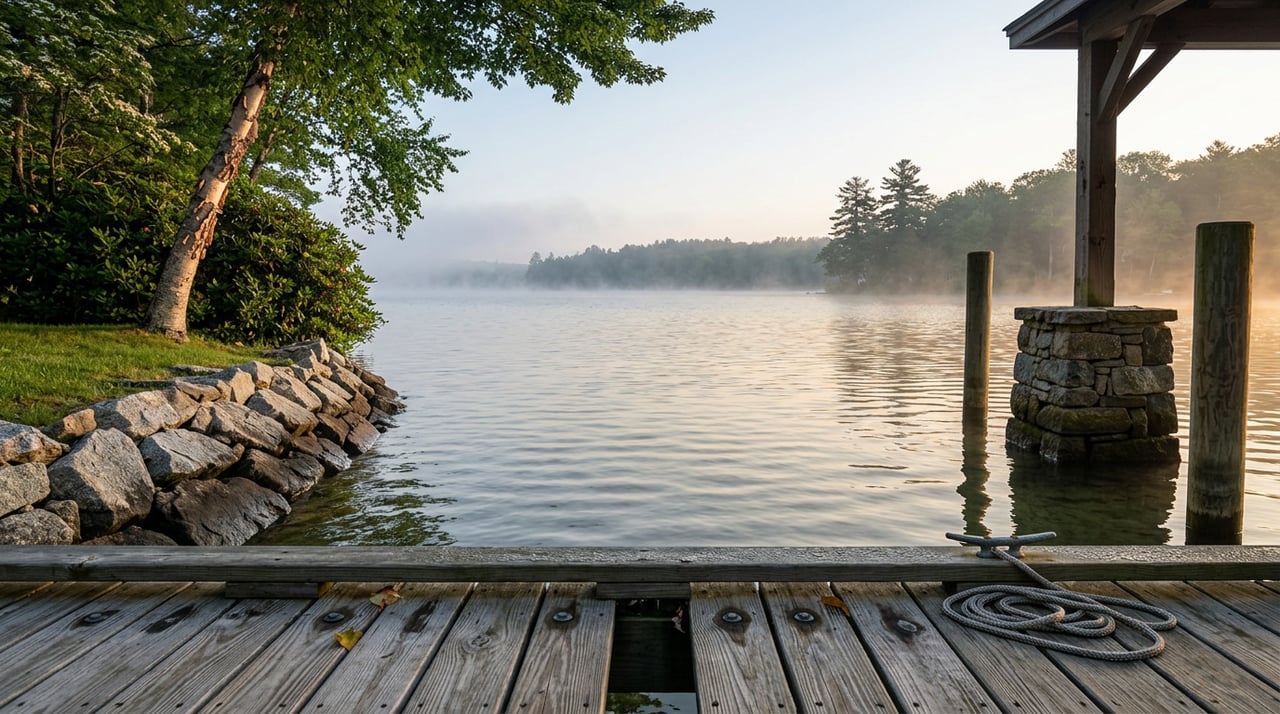
If you're closing on a Lake Chatuge waterfront home this year, ask your agent one question before you ask about the view: is the dock permit in the seller's name. On this lake, all docks must carry Tennessee Valley Authority approval, and that approval doesn't just ride along with the deed. It has to be transferred, and if the paperwork isn't clean, you can find yourself owning a house on the water with no legal way to keep a boat at it.
That detail matters more this year than most, because Lake Chatuge just lived through two years of a very public dam story, and the story left a mark on the market that most people are reading backward. The headline everyone remembers is that the Tennessee Valley Authority floated an eight-year lake drawdown to fix a failing spillway. The number that actually moved was not the one anyone expected.
The Number Everyone Missed
Prices barely flinched. Deals disappeared.
According to a Lake Chatuge market report published in the spring of 2026, 26 lakefront homes sold in 2025 compared to 36 the year before, a drop of more than a quarter in transaction volume. Average sold price, meanwhile, slipped from $1,212,483 in 2024 to about $1,194,798 in 2025, a decline of under 1.5 percent. The report attributes much of the slowdown directly to uncertainty around the TVA spillway issue, which it notes has since been resolved in a positive way for the lake.
| Year | Lakefront Homes Sold | Average Sold Price |
|---|---|---|
| 2024 | 36 | $1,212,483 |
| 2025 | 26 | $1,194,798 |
That gap between a 28 percent drop in volume and a 1.5 percent dip in price is the actual story. When buyers and sellers face a scary, unresolved risk, the textbook expectation is that price absorbs it: sellers cut, buyers get a discount, the market clears at a lower number. That is not what happened here. Instead, the deals that would have happened at the margin simply didn't happen. Sellers who weren't forced to sell waited it out. Buyers who weren't in a hurry sat on cash. The properties that did trade, traded at close to the old price, because the people willing to transact during the scare were the ones least sensitive to it in the first place.
How We Got Here
The alarm started in the spring of 2025, when TVA floated five alternatives for repairing the Chatuge Dam spillway, ranging from doing nothing to a full rebuild. The worst-case estimates were jarring: up to eight years of reservoir drawdown under one alternative and up to six years under another.
By June 25, 2025, the picture had changed. TVA narrowed the field to three remaining options, and none of them called for more than two years of drawdown, and none touched the late spring or summer months. The eight-year scenario was off the table entirely.
"This is a big win for the Lake Chatuge community."
That's Kevin Clem, third-generation owner of Boundary Waters Resort and Marina and spokesperson for SaveLakeChatuge.org, describing the June 2025 announcement. The timeline since has held roughly steady. TVA's own project page still says the agency does not have a preferred alternative, a status confirmed as recently as January 2026 radio interviews with the agency's dam safety project manager. An April 2026 update from Georgia Outdoor News reported that TVA is also studying a permanent minimum-flow pipe as part of the project, which pushed the draft Environmental Impact Statement to Fall or Winter 2026 without adding to the actual construction timeline. A final decision is still expected in early 2027, with construction not starting before late 2027 or 2028.
Worth separating out here: Chatuge already drops close to ten feet every winter as part of normal flood-control operations, the same as it has for decades. That routine swing is not what scared the market. What scared the market was the possibility of an additional drawdown stacked on top of the normal cycle, for years at a time, during boating season. That version of the story is now off the table under every alternative TVA is still considering.
Why Price Held While Deals Disappeared
The mechanism here is worth sitting with if you're weighing a Chatuge purchase against another lake. Uncertainty about a shared, lake-wide risk doesn't usually get priced into an individual sale the way a bad roof or a failed septic inspection does, because no single seller can credibly discount for a risk that might not affect their specific cove, and no buyer can easily verify how much of that risk is real versus rumor. So instead of negotiating over it, both sides tend to walk away from the table. Volume drops. Price holds until someone with real motivation forces the issue.
That's consistent with what happened here. The report notes that well-located, well-presented homes continued to command strong prices even during the two years of uncertainty, while overall transaction count fell. If you were shopping the lake in 2025, you likely saw fewer listings and fewer closings, not steep discounts.
The Dock Question That Still Matters
Resolution at the policy level doesn't automatically resolve risk at the property level. Two homes a quarter mile apart on Chatuge can carry very different exposure depending on where they sit relative to the dam and how the shoreline is shaped. Before you write an offer, walk through a few things with whoever is representing you:
- Is the dock permit currently active, TVA-approved, and in the seller's name, or will it need to be transferred as part of closing
- How steep is the drop from yard to water, since a gentle bank stays usable through seasonal swings in a way a steep rocky bank does not
- Is the property in a narrow upper cove or closer to the main body of the lake near the dam, since coves at the head of the lake typically show more shoreline change during any drawdown than open water closer to the dam
- What does the dock look like at winter pool, not just at the summer level you're touring it at
None of these questions require you to distrust the lake. They require you to evaluate the specific piece of shoreline you're buying, the same way you'd evaluate a foundation or a well.
What This Means If You're Buying Now
Full-year 2026 sales numbers aren't out yet, and that gap is itself informative. The policy risk was substantially resolved by the summer of 2025, but buyer sentiment doesn't reset the day a press release goes out. Confidence tends to rebuild slower than the underlying facts change, which means the window between "the scary version of the story is dead" and "everyone has caught up to that fact" is often where a patient buyer finds the best combination of selection and price. If 2025's reduced volume reflected lingering caution more than reduced demand, the properties that were held off market during that period may start reappearing as sellers regain confidence, which is worth watching for anyone comparing Chatuge to other regional lakes right now.
What This Means If You're Selling Now
The narrative has shifted in your favor, but buyers doing their homework will ask about the dam study, and a vague answer reads as a red flag even when the real news is good. Come to the table with the timeline in hand: worst case is off the table, no summer impact under any remaining alternative, decision not due until early 2027. Pair that with clean, transferable dock paperwork and you remove the two things most likely to make a buyer hesitate before they even see the house.
Frequently Asked Questions
Is it safe to buy on Lake Chatuge with the dam study still open? TVA has been public that the dam is not in an emergency condition, that it doesn't view the spillway issue as urgent, and that Hiawassee's drinking water supply would not be affected under any of the alternatives being studied. Monitoring has been increased while the study continues.
Will there be a drawdown in 2026 or 2027? No decision has been made. Construction is not expected to begin before late 2027 or 2028 at the earliest, so no project-related drawdown is scheduled before then. The lake's normal winter drop will continue as it always has.
Does this affect homes near the lake but not directly on the water? The volume and pricing impact documented so far is specific to waterfront transactions. The tourism-dependent side of the local economy was part of the original concern, but the scaled-back alternatives, none of which touch the summer season, sharply reduce that exposure.
If you're weighing a Chatuge purchase against another lake, or trying to time a sale around what's actually happening with the spillway instead of what people remember hearing in 2025, I've been tracking this one closely since it started. Melissa Jenkins Stillwell can walk you through a specific property's dock records, cove position, and real exposure before you write an offer. Schedule a free consultation and let's look at the actual paperwork together.